
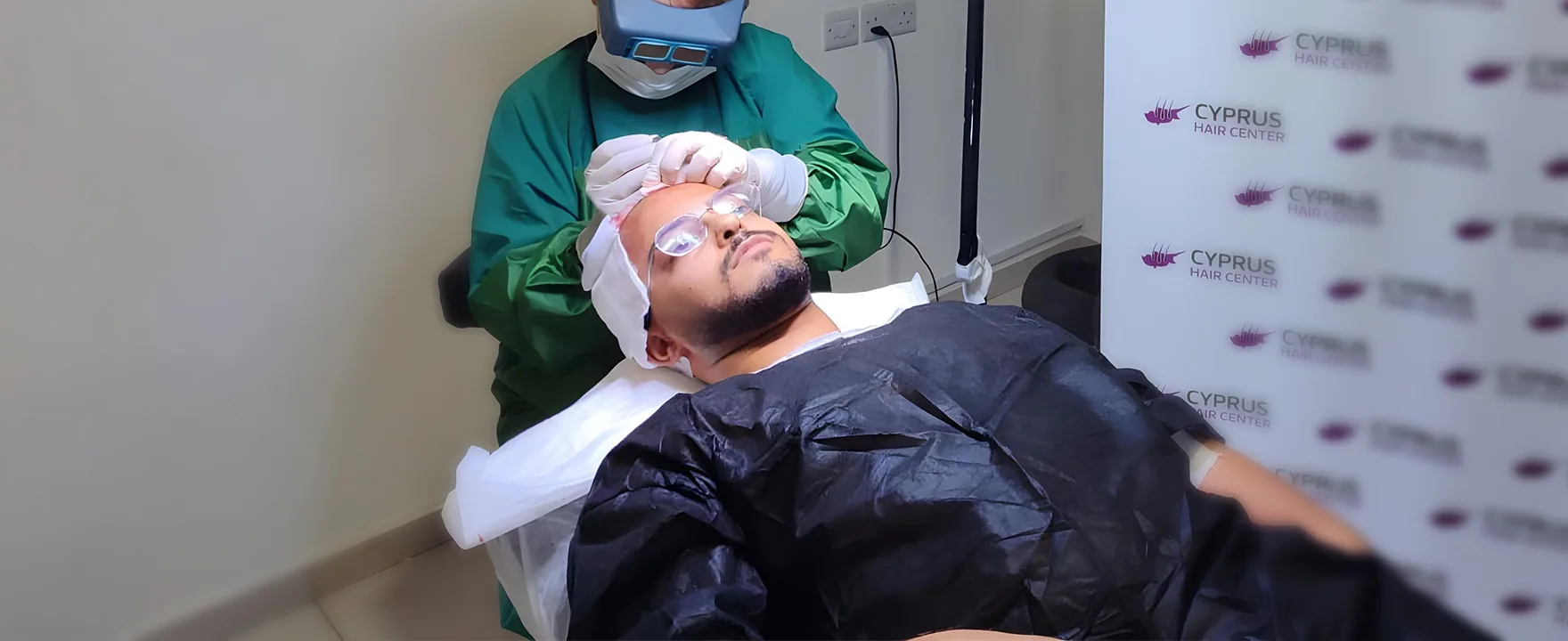
A sapphire FUE hair transplant is carried out with the FUE (follicular unit extraction) technique, with one difference that changes the whole recovery: the channels your grafts go into are opened with tips made from sapphire rather than steel. At Cyprus Hair Center in Nicosia, North Cyprus, sapphire FUE is the technique most of our hair transplant patients choose, and every procedure is planned around your own hairline and donor area rather than a standard template.
What sapphire tips change in a FUE hair transplant
Classical FUE uses slit metal tips, which open wider channels and can lengthen healing. Sapphire allows far smaller micro-channels, so crusting is reduced and recovery moves faster.
Angle, direction and density decide how the finished hair reads, so each is planned deliberately rather than settled in the moment. The channels are opened to match the thickness, direction and natural exit angle of your own hair, which is why a well-planned sapphire FUE result does not look transplanted.
Advantages of the sapphire FUE technique
- Sapphire is a hard, inert material that keeps a clean, sharp edge
- Smooth, hard, durable tips open channels cleanly
- Smaller channels allow denser placement, and density is what reads as natural
- Less fluid is needed under the skin, so there is less swelling afterwards
- Smaller channels heal faster, with minimal crusting
How a sapphire FUE hair transplant is performed
- Assessment and planning. You send photographs, we examine your donor area and estimate the number of grafts you need, and blood work is completed before a date is confirmed.
- Hairline design. Your hairline is drawn with you at the mirror, following your facial proportions and the direction your hair naturally grows.
- Extraction. Under local anaesthesia, grafts are taken one by one from the donor area with tips of 0.6 to 0.8 millimetres.
- Channel opening. Smooth sapphire tips of 1 to 1.5 millimetres open the micro-channels at the planned angle and density, which many patients find more comfortable during the operation.
- Implantation. The grafts are placed into the channels one by one, following the natural pattern of your hair.
Recovery and results after sapphire FUE
Most patients feel well within a couple of days. The small scabs in the transplanted area typically clear within 7 to 10 days, so many people plan around a week to ten days away from the office. A temporary shedding of the transplanted hairs in the first weeks, known as shock loss, is a normal stage and not a cause for concern.
New hair starts to grow from month 3. By around 12 months the final, permanent and natural result is in place, and your medical team follows your progress throughout that year.
Where else sapphire tips are used
Because sapphire blades suit channel opening so well, the same approach is widely used in beard and moustache transplants and eyebrow work. The faster recovery compared with other techniques is a large part of why patients ask for it.
If you would rather keep your hair long, compare sapphire FUE with a DHI hair transplant, where grafts are placed with implanter pens, or with an unshaven DHI hair transplant. Your assessment decides which technique suits your donor area and your goals.
Having your sapphire FUE hair transplant in Cyprus
For patients travelling from abroad, we offer all-inclusive packages covering transfers and accommodation, so the whole trip is organised before you land. The procedure takes place in our fully equipped, sterile operating rooms in Nicosia, and the same team stays in contact with you after you fly home.
Book your personalised hair analysis
If you want a permanent answer to hair loss, the next step is a personalised hair analysis. Contact the Cyprus Hair Center team whenever suits you, send photographs over WhatsApp, and we will tell you honestly what a sapphire FUE hair transplant can achieve for your donor area and your goals.
You may also want to read about our DHI hair transplant technique, the unshaven DHI hair transplant option if you would rather not cut your hair, or scalp micropigmentation for added density.