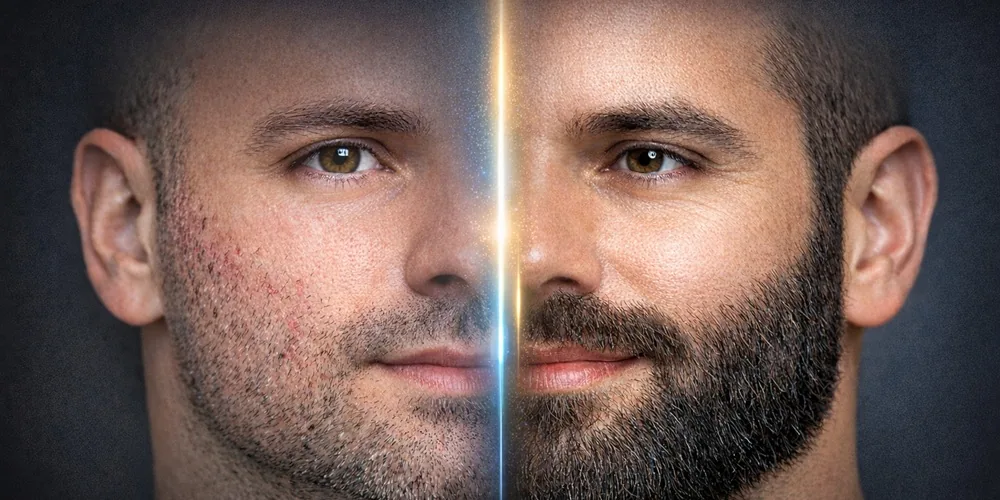
A hair transplant is the rare procedure where the surgery is the quick part and the result takes a year to arrive. Knowing the sequence in advance is what keeps the difficult months bearable — because there are difficult months, and they are normal.
Days 1–10: healing on the surface
The scalp is red, small crusts form around each graft, and swelling on the forehead peaks around day three or four before settling. Most patients are back at light work within a week, and the redness fades over weeks two to three. Sleep with your head raised, pat the scalp dry rather than rubbing, use the saline spray and the gentle washing routine you are given, and touch nothing.
Weeks 2–8: shock loss
The transplanted hairs shed — most of them. Some of your native hair around the area may thin at the same time. This is the stage that convinces people something has gone wrong, and it is the most predictable part of the whole timeline: the follicles stay rooted and alive, release their shafts after the trauma of relocation, and reset for new growth. It typically runs from week two to week eight, occasionally stretching into month four.
Months 2–3: the quiet phase
The hardest stretch psychologically, because nothing visible happens. The scalp may look as bare as before the operation while the follicles sit dormant underneath, and lingering numbness slowly gives way to tingling as nerves recover. Our honest advice: stop auditing the mirror daily. Take one photo a month in the same light instead — progress is real but too slow for daily inspection to see.
Months 4–5: first growth
New hairs appear — fine, soft and lightly pigmented at first, sometimes growing in odd directions before they settle. Growth is patchy and uneven between areas, and one side often runs ahead of the other. By month five roughly a third of your final density is visible. Asymmetry at this stage predicts nothing about the final result.
Month 6: the turning point
Around half to sixty percent of final density is in, the new hairs have gained colour and calibre, and this is usually the first month you can style your hair and recognise yourself again. Most patients describe month six as the moment the decision starts feeling obviously right.
Months 7–9: filling in
Density climbs to roughly seventy or eighty percent. The hairline softens into something that reads as grown rather than placed, native hair that shed during shock loss has returned, scalp sensation is close to normal, and the donor area has healed fully.
Months 10–12: the final result
The last stretch is refinement: hairs thicken to their final calibre, texture settles to match your native hair, and the dot scars in the donor area fade toward invisible. By month twelve you are looking at the result — which is why we judge outcomes, and photograph them, at a year and not before.
Caring for it along the way
Through the first weeks: no direct sun on the scalp, no heavy sweating, no smoking, nothing harsh. From around week three, light exercise returns; heavier training waits longer. After the first months it becomes ordinary good maintenance — any medication your physician prescribed, decent protein intake, sleep, and avoiding styles that pull hard at the roots. Your scheduled photo check-ins with our team run through the whole year.
When to contact your clinic
Some shedding is seasonal and normal at every stage. What is not part of the plan: sudden patchy bald spots, persistent pain or burning, hairs snapping at the scalp line, or any sign of infection — pustules, discharge, spreading redness. Send us a photo the day you notice any of these, not at the next scheduled check-in.
This article is general information written by our medical team and is not a substitute for individual medical advice. Please consult a physician about your specific situation.

Cyprus Hair Center
Written by our medical team. Every procedure at Cyprus Hair Center is performed by experienced specialists in line with international standards, and carries a lifetime warranty certificate.